


Porter, Power, and the London Beer Flood

Lady Valerie Meux spent money as if were water. What she spent on her lavish lifestyle was of little consequence. There was always more money.
And the money came from the beer, particularly porter, dark, well‑hopped, and brewed with brown malt.
The family-owned Meux Brewery was a licence to print money.
Developed in early eighteenth‑century London, porter became the drink of choice for street and river porters, who gave the beer its name. At a time when the city’s water supply was unsafe, porter was consumed in extraordinary quantities.
Founded in 1764, the Horse Shoe Brewery quickly grew into one of London’s major producers of porter. By 1792 it belonged to John Stephenson the younger, and after his early death in 1794 passed to Edward Biley. Biley ran the brewery until 1809, when he entered into partnership with John Blackburn and Edward Gale Bolero.
In 1807, following a dispute among the partners of Reid, Meux & Co. at the Griffin Brewery in Liquorpond Street, Clerkenwell, Henry Meux left the firm and acquired the Horse Shoe Brewery. Trading thereafter as Henry Meux & Co., the business adopted the horseshoe as part of its identity and logo.
The first Sir Henry Meux constructed a vast porter vat, 23 feet high and capable of holding 3,600 barrels. Contemporary observers claimed that a million people could have marched past it in single file, each taking a pint, before it ran dry. By 1811 the brewery was producing 103,502 barrels annually, making it the sixth‑largest porter brewer in London. In 1813–14 it merged with, or acquired, Clowes & Co. of Bermondsey.
Then came the London Beer Flood, one of the city’s strangest and most tragic industrial disasters. On 17 October 1814, at about 5.30 pm, the corroded hoops of a giant vat suddenly failed, releasing around 7,600 imperial barrels (270,000 gallons) of porter. The force of the escaping beer shattered brewery walls and collapsed heavy beams. A torrent of porter surged into Tottenham Court Road and Oxford Street, sweeping people away.
The surrounding neighbourhood, flat, overcrowded, and notorious for its squalid “rookery” housing, was catastrophically vulnerable. Many homes had cellars that quickly filled with beer. Residents scrambled onto furniture to escape the rising tide. Several houses were destroyed, and at least eight people were killed; hundreds more were drenched or intoxicated by the flood.
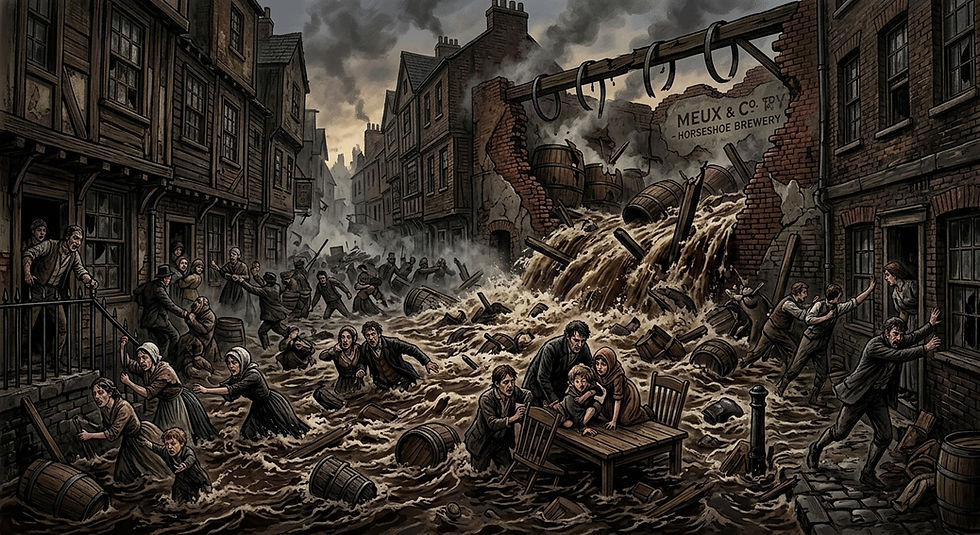
The dead were: Eleanor Cooper, 14; Mary Mulvey, 30; Thomas Mulvey, 3; Hannah Bannfield, 4 years 4 months; Sarah Bates, 3 years 5 months; Ann Saville, 60; Elizabeth Smith, 27; and Catherine Butler, 65.
George Crick, a storehouse clerk who lived nearby at 215 Tottenham Court Road, had worked at Meux’s breweries for seventeen years. Standing on a platform thirty feet from the vat when it burst, he later described the scene: the crash, the sudden surge of beer up to his knees, the rescue of his injured brother, and the devastation inside the storehouse. The vat, he said, had given way “as completely as if a quart pot had been turned up on the table.” A brick wall 22 inches thick and 25 feet high was blown out. Thousands of barrels were lost, and the adjoining vat, holding another 3,500 barrels, was damaged, though about 800 barrels were saved.
Crick noted that the vat had been built ten years earlier and was usually kept full. Hoops occasionally burst (two or three times a year) but were not considered dangerous. He had even reported a loose hoop an hour before the disaster, but was assured by a partner, Mr Young, that no harm would come of it.
Other witnesses gave similarly grim accounts. Richard Hawes, landlord of the Tavistock Arms in Great Russell Street, heard the crash and found his cellar destroyed and filled with beer. His servant, Eleanor Cooper, was buried under debris and later found dead beside a water butt. Bricklayer John Cummins described the recovery of bodies in New Street, where most fatalities occurred. Survivors were taken to Middlesex Hospital, many badly bruised but expected to recover.
The jury concluded that the victims had died “casually, accidentally, and by misfortune.”
The disaster cost the brewery around £23,000, though a parliamentary petition for £7,250 in excise drawback prevented bankruptcy.
In 1831 Henry Meux was knighted by William IV, becoming the first of several brewery magnates to receive honours from the Crown, an emerging elite soon nicknamed the “Beerage.”
Despite the catastrophe, the Horse Shoe Brewery remained one of London’s leading producers of porter throughout the nineteenth century.
Sources:
New-York Daily Tribune, Wednesday, 25 April 1906;
Evidence to the inquest into the deaths held at St Giles Workhouse. See: Caledonian Mercury, Edinburgh, Monday, 24 October 1814.
Ware, J. Redding, Passing English of the Victorian era, a dictionary of heterodox English, slang and phrase, Routledge, London, 1909.


Comments